AI is the Ultimate Expression of Open Source
-
AI is the Ultimate Expression of Open Source
Someone left this comment on my blog last week:
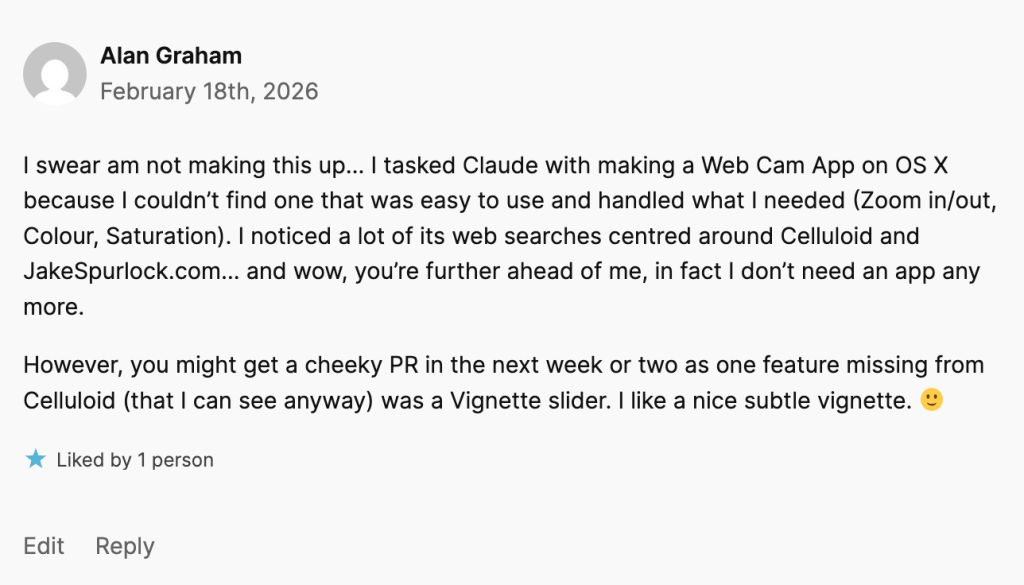
“I swear am not making this up… I tasked Claude with making a Web Cam App on OS X because I couldn’t find one that was easy to use and handled what I needed (Zoom in/out, Colour, Saturation). I noticed a lot of its web searches centred around Celluloid and JakeSpurlock.com… and wow, you’re further ahead of me, in fact I don’t need an app any more.
However, you might get a cheeky PR in the next week or two as one feature missing from Celluloid (that I can see anyway) was a Vignette slider. I like a nice subtle vignette.”
Read that again. Here’s what happened:
- I built Celluloid — a macOS virtual camera app — using AI tools
- Alan tried to build the same thing using AI tools
- Claude’s research surfaced my work
- He didn’t need to build it anymore
- He left a feature suggestion — a vignette slider
- I added it to the app
The loop closed. We’re both further ahead.
The Flywheel
Open source has always been about this: someone builds something, shares it, others use it, some contribute back. The commons grows. Everyone benefits.
But there was friction at every step:
- Building required deep expertise and time
- Discovery meant knowing where to look
- Contributing meant understanding someone else’s codebase
AI removes that friction.
Creation: I shipped six apps working nights and weekends. Not because I suddenly became a better programmer, but because AI let me move faster. Ideas that would have stayed in my head became real software.
Discovery: Alan didn’t find Celluloid by searching GitHub or Hacker News. He found it because Claude — in the process of trying to help him build a webcam app — kept pulling up my code and my blog posts as reference material. The AI discovered the existing solution while trying to create a new one.
Contribution: The vignette feature Alan mentioned? I built it five days later. It’s already merged. The feedback loop between “I wish this had X” and “here it is” has collapsed.
This Isn’t Hypothetical
I’m not theorizing. This is my actual workflow.
Recently I shipped:
- Today — an RSS reader for iOS and Mac
- ScriptStrip — local transcription for macOS
- Jewel Case — Spotify album art display
- Celluloid — virtual camera with filters
- Draft Night — Little League draft software (open source)
- WalkUp DJ — walk-up music for baseball and softball
All built with AI assistance. All open source or indie. All feeding back into the ecosystem that made them possible.
The models that helped me build these apps were trained on decades of open source code. Now my code becomes part of what trains the next generation. The flywheel spins.
What Open Source Promised, AI Delivers
The original dream of open source was democratization. Anyone could read the code. Anyone could learn. Anyone could contribute.
In practice, “anyone” meant “anyone with the time and expertise to understand a complex codebase.”
AI changes the denominator.
When Claude helps Alan understand my code well enough to contribute a feature, that’s not cheating — that’s the promise of open source finally being delivered. The knowledge isn’t locked behind years of experience anymore. It’s accessible.
More builders means more software. More software means more training data. Better training data means better AI. Better AI means more builders.
The commons grows faster than ever.
The Skeptic’s Objection
“But you’re just generating slop with AI!”
Look at the results. Celluloid works. People use it on Zoom calls. Alan found it useful enough that he didn’t need to build his own — and valuable enough that he’s contributing improvements.
The quality bar is the same as it ever was: does the software solve a problem? Does it work? Will you maintain it?
AI doesn’t change those questions. It just lets more people attempt answers.
Where This Goes
I don’t think we’ve fully internalized what’s happening.
Every open source project is now more discoverable — not through SEO tricks, but because AI assistants will surface them when someone tries to solve the same problem.
Every contribution barrier is lower — not because standards dropped, but because understanding code got easier.
Every builder has more leverage — not replacing expertise, but multiplying it.
Open source always had network effects. AI supercharges them.
Alan tried to build a webcam app. He found mine instead. His suggestion made it better.
That’s not a bug in the system. That’s the system working exactly as intended — just faster than we ever imagined.
The vignette slider is live in Celluloid. Thanks for the suggestion, Alan.
Related: I’m Shipping Like I Have a Team. I Don’t.
#AI #AppDevelopment #AppleDevelopment #apps #Claude #MacOS #OpenSource #software

Hello! It looks like you're interested in this conversation, but you don't have an account yet.
Getting fed up of having to scroll through the same posts each visit? When you register for an account, you'll always come back to exactly where you were before, and choose to be notified of new replies (either via email, or push notification). You'll also be able to save bookmarks and upvote posts to show your appreciation to other community members.
With your input, this post could be even better 💗
Register LoginWelcome To Podcasting.Chat!
This forum is for podcasters, podcast guests, and podcast enthusiasts alike to share tips, tricks, and their love of the medium.
This forum is fully federated, so you are able to contribute to any discussion here through your own software of choice (e.g. Mastodon, Misskey, Lemmy, Piefed, etc.). So you can sign up for an account here and it federates around the Fediverse. You can also follow feeds and topics from your other Fedi-enabled accounts.
Recent Posts
-
@Nerdfest Agreed. But today is National Polar Bear Day. So I highlighted them.
-
@ChadF @DavidMarzalC You can mute it.
-
just hope it doesn't flood the timeline here
-
New issue in Podcastindex-org/podcast-namespace: Proposal: A tag to list a few introductory or "listen to these first" episodes (#385)
After going on for a while, a podcast might end up with one or a handful of episodes which the podcast creator feels are the best starting point for a new listener – because they introduce the topic of the podcast in a good way, or the c...

GitHub (github.com)